Stellantis Patent Previews A Clever Next-Gen Hybrid System
Stick it in front of the transmission and you can take advantage of gearing, but you're also stuck with power drops between shifts. Put it behind, and you get a smoother experience but need a much more powerful motor for the same effect. A new patent from Stellantis could give the best of both worlds and potentially maximize range as well as performance based on what the driver demands.
The patent, which was issued August 5, has a terrifically long, technical name which we will simplify as optimum shifting of electrified powertrain systems. The abstract is filled with more techno-speak, but it explains in general terms how this all works. The idea is for a way to control a powertrain that has motors in front of and after the transmission, and how to optimally split torque delivery between them for the best experience.
System Could Better Handle Post-Shift Torque
In the filing, Stellantis engineers claim that current systems with motors before and after the gearbox normally jump to the post-shift torque during or to either side of the shift. When they do, it's not great for range or drivability. There are losses from heat, slipping clutches, and because of the multiple sudden torque changes. It claims this has only become a problem recently, as motor responses have gotten better.
Sensors would monitor the drive system and send inputs to the controller. The controller would solve the equation to find the optimal torque split, then direct the motors to do their thing.
The patent shows four examples of possible splits. In some cases, the motors will be commanded to smoothly shift all torque to the post-transmission motor, while others are more abrupt. In two of the examples, there is always some torque applied by the front motor, though it's not clear why. Once the gear shift is completed, the torque split returns quickly to the post-shift optimal value.
It's the kind of system that you'd likely never notice in operation. Shifts might be smoother, but the real difference would come from efficiency. It's not clear from the filing what improvements could be expected, but the system should deliver better use of the battery's charge.
No Current US Models Could Use This Tech
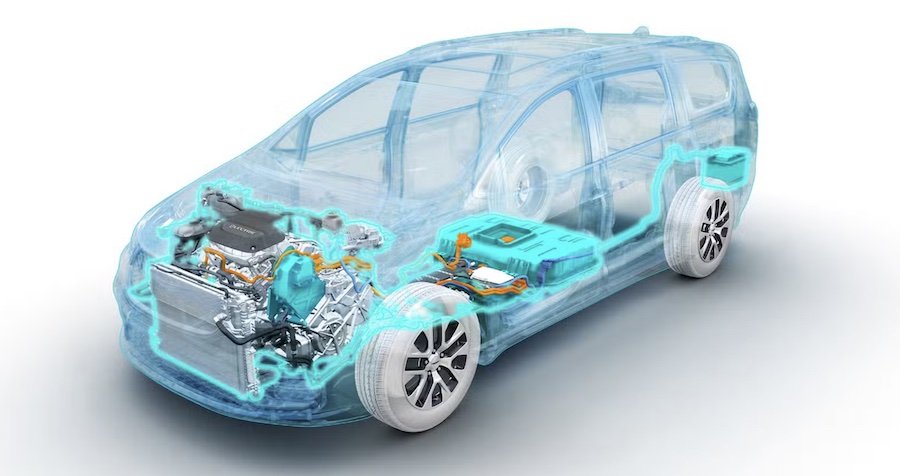
Currently, Stellantis has just one model in the US that might be able to take advantage of the system. The 4xe system as found in the Wrangler and Grand Cherokee models uses a motor mounted in front of the transmission. Ram's E-Torque uses a belt-driven motor-generator attached to the engine's accessory drive, and the Hornet/Tonale PHEV uses an electric motor mounted to the rear axle to drive those wheels. The Chrysler Pacifica PHEV integrates two electric motors into its e-Flite transmission, therefore might be capable of using this new tech.
Of course Stellantis is planning lots more electrified models. In Europe, a new eDCT transmission is just entering production. In the US, it plans the Ramcharger range-extended model. That one won't use the engine to drive the wheels, but it's possible and even likely that the company's brands will develop more systems.
