Polestar’s future revealed: Radical coupé shows sporting ambitions
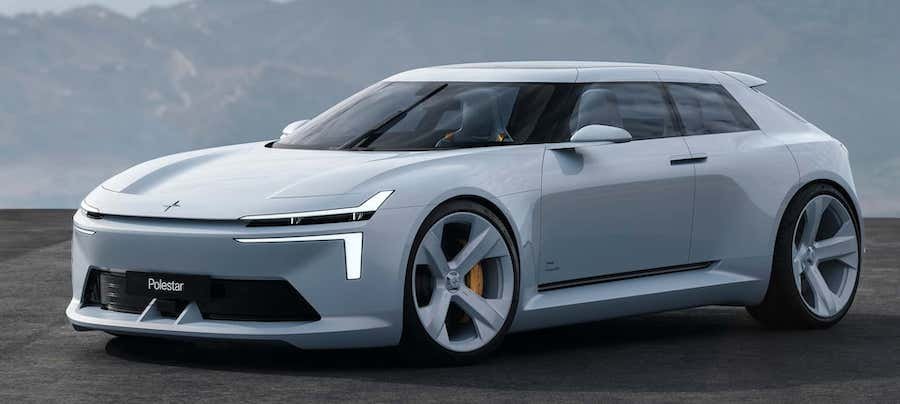
Polestar has pledged to make performance car thrills a higher priority in its future line-up with the unveiling of its new, driver-centric Formula 2030 concept.
The four-door 2+2 hatchback is in the mould of the Hyundai Ioniq 5 N and sets the tone for a more sporting design ethos. It also previews specific features that are destined for forthcoming models, including the next-generation, BMW i3-rivalling Polestar 2, and the all-new 7 compact SUV.
Created under the leadership of former Audi exterior design boss and self-confessed sports car lover Philipp Römers, the Formula 2030 blends Polestar's double Thor's Hammer headlights onto a front bearing a central wing and lengthy bonnet.
The nose, which strongly hints at the successor to the 2, sweeps back to a windscreen with a central wiper inspired by Polestar's motorsport past - specifically the single-wiper Volvos it fielded in European touring car championships from the 1990s to the 2010s.
Even the four-spoke alloys are said to provide a glimpse of a future Polestar wheel design, while the use of rear-hinged back doors clears space for longer front doors, although this is one of the show-car's more obviously conceptual elements.
Its coupé-inspired look, along with the aggressively swollen wheel arches, harks back to Polestar's first stand-alone model, the 1, and helps to emphasise a reinvigorated performance vibe, as does the new shade of Nitrogen Blue paintwork.
The rear, however, is more shooting brake than hatch, with a heavily raked screen and bootlid, which then cuts back in towards the floor of the car. At the bottom, prominent aerodynamic blades hint at an aero-focused underside, while the new rear lights and black bar together with the BMW Z8-style swollen bootlid provide the clearest glimpse of how the Polestar 7 will look.
Inside, the dashboard provides a stark contrast with the dual-screen set-up of current Polestars because it ditches the large fixed central touchscreen and swaps the minimalist driver display for a new wrap-around arrangement that curves around the back of the steering wheel to emphasise the feeling of being in a cockpit.
That's joined by a smaller touchscreen, which folds out from the centre console, complete with a physical slider to change the drive modes.
A more significant change compared with existing Polestar models comes with the fitment of customisable physical buttons at the bottom of the console. Like the customisable widgets on Polestar's current touchscreens, these mechanical switches can be swapped out for different ones, to suit a driver's preferences.
The buttons are surrounded by other analogue controls - such as knobs and dials, and buttons on the steering wheel - hinting at a change from the firm's current clutter-free and digitally focused interiors.
Polestar CEO Michael Lohscheller told Autocar recently that the firm is planning to heavily evolve its approach to interior design in response to customer feedback, which broadly called for more physical controls.
He said: "Customers are very outspoken about that. They say: 'We want more buttons. It's that simple. And yes, we will do buttons.'" The Formula 2030's cockpit gives a good idea of how that new ethos will manifest in future cars.
The front bucket seats feature active inflating bolsters for high-load cornering. Similarly shaped individual chairs in the rear make this a 2+2, although Polestar is expected to continue to equip its production cars with a full-width rear bench.
The firm has not disclosed any official measurements for the Formula 2030, but in the metal it appears to have a similar footprint to the Ioniq 5, which is 4655mm long and 1890mm wide, although it's a lot lower in profile than the Hyundai.
The boot features storage spaces for crash helmets, further alluding to the performance focus, and attention is drawn to the suspension's exposed gold Öhlins remote reservoirs, which become visible at the base of the C-pillars when the hatch is open.
Polestar is no stranger to adjustable suspension with this sort of hardware. Indeed its new 5 saloon and 4 SUV both use adjustable damping solutions. But the Formula 2030 goes one step further with electronically controlled damping that works alongside a steer-by-wire system, dispensing with mechanical linkages between the driver and the front wheels. The firm has not said whether this tech will make it into showrooms, but Toyota, Mercedes and Peugeot are bringing steer-by-wire to production cars, while Polestar parent company Geely will deploy such a system in its upcoming K011 off-roader.
This, along with the sustainably sourced and bio-grown materials of the body and cabin, comes as part of Römers' desire to cut back on unnecessary components.
To trim CO2 and boost sustainability, the car's materials include plant-based solutions, developed with cleantech company Bcomp. The Swiss firm already produces natural composite materials for the Polestar 5 and the structure of the Formula 2030 is said to be made from its carbonfibre alternative.
Elsewhere, galvanised steel produced using renewable energy is left exposed, reducing material usage and making more of a statement.
Polestar refrained from hinting at what layout of electric powertrain would drive the Formula 2030, because it's not intended to directly become an equivalent production model. But Römers said Geely has platforms that could easily support such a vehicle, including the SEA structure that underpins the 4 and is likely also to provide the basis for the 2 successor and the 7.
Were the concept ever to evolve into a production model, it would not be short of similarly sized, low-slung performance EV rivals, such as the Ioniq 5 N, Kia EV6 GT and BMW M3 EV.
Nevertheless, Polestar told Autocar that the focus for the next few years is on higher-volume models, with the recently launched 4 SUV expected to overtake the 4 Coupé as its best-selling car. That is at least until its BMW iX1-rivalling 7 slots into one of Europe's most in-demand segments in 2028.
