2027 Porsche Taycan Gets Virtual Gearshifts, Better Range, New Colors, Manthey Performance Upgrades
The Porsche Taycan has been the cornerstone of Porsche’s electric dreams, being its first production EV and setting a sales record in its first year of production.
That was almost seven years ago, and times have certainly changed since then, on multiple levels. Porsche now offers a Macan EV and a Cayenne EV in two body styles, albeit its electric lineup was supposed to also include a lager 7-seat SUV and all-electric replacements for the 718 Cayman and Boxster by the end of 2026.
Those plans have been switched to modify those platforms for combustion engines as well, and one of main reasons behind it was the downward evolution of Taycan sales, not to mention its horrible depreciation curve. With that in mind, the Taycan remains an important model for Porsche, and considering it’s based on a proprietary architecture, only shared with the Audi e-tron GT, there was a lot of money pumped into its development and production.
Despite receiving several updates and a mid-cycle facelift since its introduction, Porsche has decided to sweeten the pot even more for the 2027 Taycan, which they hope will convince more people that they need what Stuttgart is offering in this segment. The host of upgrades is rather extensive for a model year update, and it arrives just in time to soften the blow brought by the controversial-looking but technically more adept Mercedes-AMG GT 4-Door Coupe.
While not as extensive as an actual mid-cycle facelift, the modifications done to the car for the 2027 model year are skin deep, both literally and figuratively. Some of them are all about improved performance, others about increasing efficiency, and last, but certainly not least, some are about improving the experience of its passengers with the model.
Hyundai N’s Virtual Gearshifts Arrive at Porsche in Full Swing
By far the most talked about update on the refreshed 2027 Taycan lineup will be what Porsche calls “E-shift” function, which comes via a new steering wheel with “gear paddles.” Instead of keeping it on “auto,” drivers will be able to shift between eight virtual gears via the paddles, and the system is complete with simulated gear-shift jerks, engine-braking like on a combustion model and a modified interior and exterior “Porsche Electric Sport sound.” There is also a virtual rev counter that goes to 8,000 rpm and has what appears to be a 7,200 rpm redline.
The E-Shift function will be standard on the Turbo GT and optional on all other Taycan versions, albeit there is no word yet on pricing. Because The Taycan lineup comprises models with power ranging from 408 PS (with Launch Control) to no less than 1034 PS (with Launch Control) on the Turbo GT, not to mention three different body styles, the virtual transmission mapping and sound characteristics will be tailored to each individual model.
The weird part? Well, first of all, Porsche is quite late to the party, with this type of gimmick having been introduced by Hyundai on the i5 N quite a few years ago and recently by the second-generation Mercedes-AMG GT 4-Door. Second of all, back in 2024, Porsche development driver Lars Kern was quoted by Australian media in saying that the carmaker had already studied what Hyundai was doing and had decided not to copy it.
Not only that, but Kern also said “obviously, we look into what the competition does, but our perspective on this is always why should we make something worse?” Which in theory it’s true, since gear shifts (simulated or real) actually make an EV slower. For example, the fastest driving mode in the Mercedes-AMG GT 4-Door isn’t the one where you can play with paddle shifters and hear a digitized V8 sound.
Fast forward a year later, and Porsche was once again “studying” what Hyundai was doing, only this time for real. Frank Moser, the vice president of the Porsche 718 and 911 model lines, was quoted saying that he had driven the Hyundai Ioniq 5 N "several times", claiming it was an "eye-opening" vehicle for the brand. Not only that, but he even managed to convert Andreas Preuninger, the man who is in charge of Porsche’s GT cars, that simulated gear shifts in an EV are not something he should despise, as he was before going for a ride in the Ioniq 5 N himself. Fast forward one more time, to June 17, 2026, and the Taycan is now the first Porsche EV to get a similar gimmick as the Hyundai i5 N and its AMG soon-to-be archrival.
More Range, but Not How You Would Expect
The updates to the 2027 Porsche Taycan are obviously more substantial than the E-Shift story alone might suggest, and one of them is arguably more important for actual Taycan customers. For them, the headline should only include the fact that some rear-wheel-drive versions of the sedan and the Sport Turismo models now get new 20-inch summer tires with low rolling resistance, which can increase the maximum range of the car by up to 20 km (12.4 miles) in the WLTP cycle.
In other words, when equipped on models that have the Performance Battery Plus upgrade, they can enable a WLTP range of up to 700 km (435 miles), the longest ever on a Taycan. Obviously, the real-life numbers will be nowhere near that, but it’s nice to see that Porsche continues to bring small improvements in this area. Whether they will be enough to keep sales afloat and maybe slightly improved the downright catastrophic depreciation rates of the model remains to be seen.
I say this because newer rivals from China and not only are already beating Porsche’s EV sweetheart in this department, all while offering much stronger performance. For example, the Mercedes-AMG GT 4-Door Coupe in 55 guise can also hit a 700 km (435 miles) WLTP range if configured correctly, all while offering performance close to the Taycan Turbo, not the RWD versions.
For the U.S. market, which has seen a serios decline for the Taycan, the base RWD version, the Taycan 4 and Taycan 4S now get the Performance Battery Plus pack (105 kWh as standard, which also comes with a higher maximum charge rating of 320 kWh on compatible 800-volt DC fast charging stations. Speaking of charging, most U.S. Taycan versions will also feature a NACS DC fast-charging port on the passenger-side fender, while the driver’s side will retain the J1772 AC port.
A built-in CCS adapter will be offered, offering direct access to Tesla’s Supercharger network without those aftermarket-looking adapters dangling from the charge port. Weirdly, the Taycan Turbo GT with the Weissach Package is exempt from receiving the NACS port. Porsche probably assumed that anyone spending a quarter million $ on an EV only charges at home and couldn’t be caught dead at a public charging station like all the other commoners.
New Infotainment System with Improved AI Features
The infotainment is the least glamorous part of the 2027 updates packages, but of most importance for people who spend significant time in the car. Porsche is finally bringing its Digital Interaction system, which already runs on the Macan Electric and the two Cayennes Electric, to the Taycan. It offers smoother menu navigation, has a response time of up to five time faster, and it also features configurable widgets.
The new infotainment system now also has a 3D vehicle model rendered in the actual color of the real car, an improved Voice Pilot AI assistant with natural conversation capabilities, and Google-supported point-of-interest search, not to mention expanded Apple CarPlay and Android Auto capabilities. Oddly enough, there is no mention of Apple CarPlay Ultra, despite Porsche having one of the longest collaborations with Apple in the business.
Even more important for actual Taycan customers is probably the addition of over-the-air-updates for the infotainment system, meaning that future improvements will arrives as software downloads instead of requiring those dreadful dealer visits. The wireless phone charger has also been upgraded to 25 watts, charging smartphones approximately 1.5 times faster than before.
Not to be left too much behind their Stuttgart neighbors wearing the three-pointed star as an emblem, the Taycan now gets a Themes app, which enables color-world customization that extends to ambient lighting and display schemes, while the Paint to Sample catalog has grown to no less than 153 colors, including 16 new ones.
One of the news ones is called Loretta Purple, and whether that represents an important-enough advancement in potential Taycan ownership again, remains to be seen. As always with a carmaker that charges for painting the entirety of the exterior mirrors and calls it customization, the Paint to Sample catalog is not just personalization, but a major revenue stream, and Porsche definitely needs that.
Performance Upgrades Courtesy of Manthey
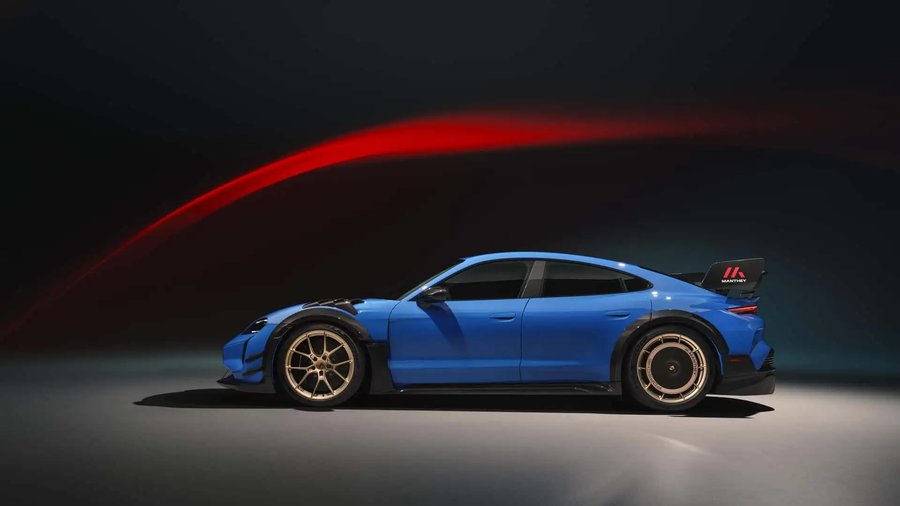
Look past the fake gear changes, the extra range and the multiple lighting and display themes, and those who desire even more track performance from a car that probably nobody takes to the track, and we find the Manthey Kit. Available strictly for the top-of-the-range Taycan Turbo GT with the Weissach Package, which you should be reminded is a four-door car for just the driver and a passenger, the Manthey Kit can now be ordered directly from the factory for the very first time.
Before, it was only available as a retrofit, kind of like a track-day equipment option that arrives after the car’s delivery. From now on, all the modifications developed by Manthey are integrated into the build process, meaning you keep the same warranty. Porsche says that the kit brings “extensive aerodynamic, chassis and powertrain optimization” that “significantly increases” the performance of the car on a circuit.
If you don’t believe it makes such a massive difference on an already capable car, a similarly equipped Taycan Turbo GT with Weissach Package and a Manthey Kit set a record time of 6:55:533 minutes on the Nurburgring Nordschleife with Lars Kern behind the wheel.
All in all, the 2027 Taycan update makes the car more practical, gives some models a slightly better range, makes the more connected, and those 2-3 people that want to take it to the track can now make it look and drive like a racing car straight from the factory. That said, the E-Shift fake gearbox (for a car that actually uses a two-speed gearbox) is what will make the most headlines. For that reason, Porsche definitely needs to thank Hyundai Kia’s Namyang R&D center.
Related News
